 Pin it
 I'll never forget the evening I first created the Infinity Loop Flow—it was during a quiet Wednesday when I wanted to cook something that felt both nourishing and extraordinary. I'd been thinking about how food could tell a story through its arrangement, and that's when it struck me: what if I could create a dish where every element spiraled into the next, like a conversation between flavors? The figure-eight shape came to me while sketching on a napkin, and suddenly, I was in the kitchen, carefully composing salmon, couscous, and vegetables into something that looked like art but tasted like home.
I remember serving this to my closest friends on a spring evening, and watching their faces light up when they saw the infinity loop on the platter was worth every careful slice and mindful arrangement. One of them said, 'This looks too beautiful to eat'—but they did, and by the end of the meal, we were all leaning back, satisfied and genuinely moved. That's when I knew this dish had become something special to me.
Ingredients
- Fresh salmon fillets (2, about 300 g): Skinless salmon is your canvas here—the mild, buttery flesh holds the delicate flavors without overwhelming. I've learned to use the freshest you can find, ideally from a fishmonger who can tell you when it arrived
- Pearl couscous (1/2 cup): This is what creates the foundation of your infinity loop. Unlike regular couscous, the pearls are plump and substantial, giving you beautiful little spheres to build your pattern with
- Zucchini, carrot, and fennel (1 medium each, thinly sliced): These vegetables are your color palette and textural contrast. Slice them paper-thin—a mandoline is your friend here, though a very sharp knife works too
- Baby spinach leaves (1 cup): Fresh spinach fills in the softer moments of the loop, adding earthiness and completing the nutritional story
- Greek yogurt (2 tbsp): This creamy base for your dressing brings richness and acts as a gentle binding force for all the flavors
- Lemon zest (1 tsp): Don't skip this—it's the brightness that makes everyone pause and ask 'what is that flavor?' The acid lifts everything
- Fresh dill (1 tbsp, finely chopped): Dill and salmon are old friends, and here dill whispers rather than shouts, keeping things elegant
- Capers (1 tbsp, rinsed): These little briny gems provide moments of piquancy throughout the loop—rinse them well to keep things balanced
- Toasted pine nuts (1 tbsp): Toast them yourself if you can; it makes all the difference. They're the final garnish that adds a gentle crunch and warmth
- Olive oil (1 tbsp) and vegetable broth (1 cup): Quality matters here—good olive oil and a flavorful broth set the foundation
- Salt and freshly ground black pepper: Season as you go, tasting constantly. This is how you learn what your palate truly needs
Tired of Takeout? 🥡
Get 10 meals you can make faster than delivery arrives. Seriously.
One email. No spam. Unsubscribe anytime.
Instructions
- Set your stage:
- Preheat your oven to 180°C (350°F). While it's warming, gather everything you'll need—think of this as arranging your kitchen like a painter arranges their palette. You want to move through this with intention, not frantically hunting for things
- Build your grain foundation:
- In a small saucepan, bring the vegetable broth to a boil. You'll know it's ready when it's rolling and fragrant. Add the pearl couscous, give it a gentle stir, then reduce the heat and cover. Let it simmer quietly for 10 minutes—this is your moment to breathe and prepare. After 10 minutes, fluff it with a fork and set it aside to cool slightly. The couscous should be tender but still have individual pearl character
- Blanch your vegetables with care:
- Bring a pot of salted water to a rolling boil—the water should taste like the sea. Working quickly, blanch the zucchini slices for about 1 minute, just until they turn a brighter green. Remove them with a slotted spoon and plunge immediately into ice water. Repeat with the carrot and fennel slices, cooking each for 1–2 minutes. This ice bath is essential—it stops the cooking and preserves those gorgeous colors. Pat everything dry carefully with a clean kitchen towel; moisture is the enemy of visual beauty
- Cook the salmon gently:
- Rub your salmon fillets lightly with olive oil, then season both sides with salt and pepper. Place them on a parchment-lined baking tray and bake for 12–15 minutes. You're looking for that moment when the flesh is just cooked through but still retains a whisper of moisture. It should flake easily with the gentlest pressure of a fork. Cool it slightly—handling warm salmon is asking for trouble—then break it into large, neat flakes. These flakes are like pieces of a puzzle you're about to assemble
- Make your creamy companion:
- In a small bowl, combine the Greek yogurt with the lemon zest and fresh dill. Stir gently, tasting as you go. This dressing should taste bright and herbaceous, with the lemon providing just enough zing to make your eyes widen slightly
- Create the infinity loop—the moment of composition:
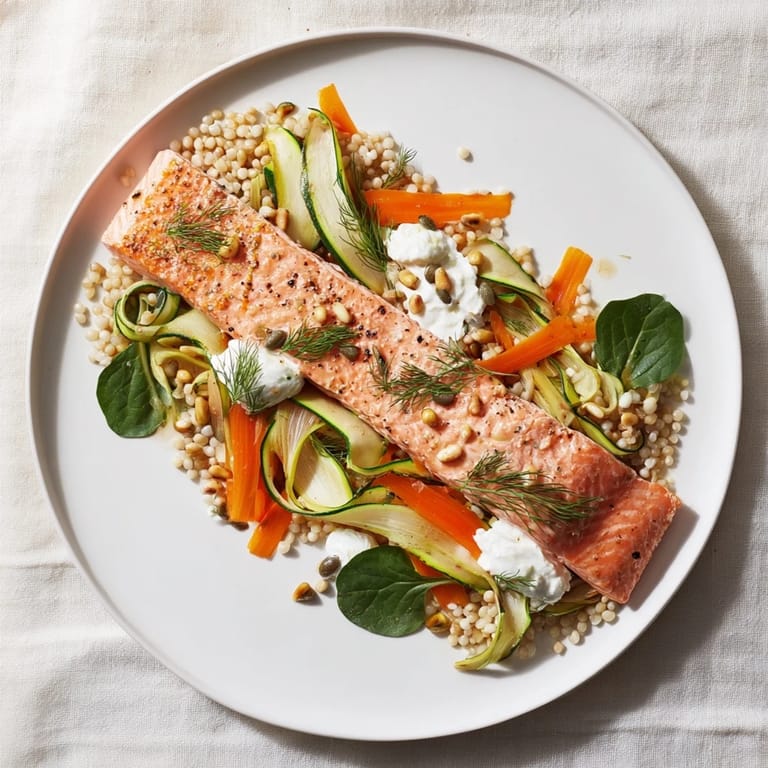
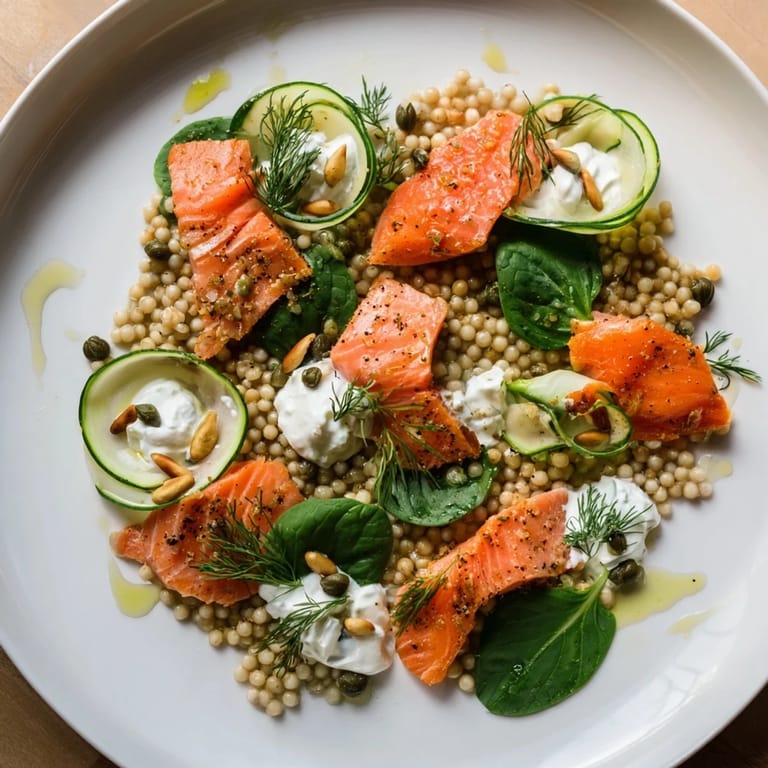
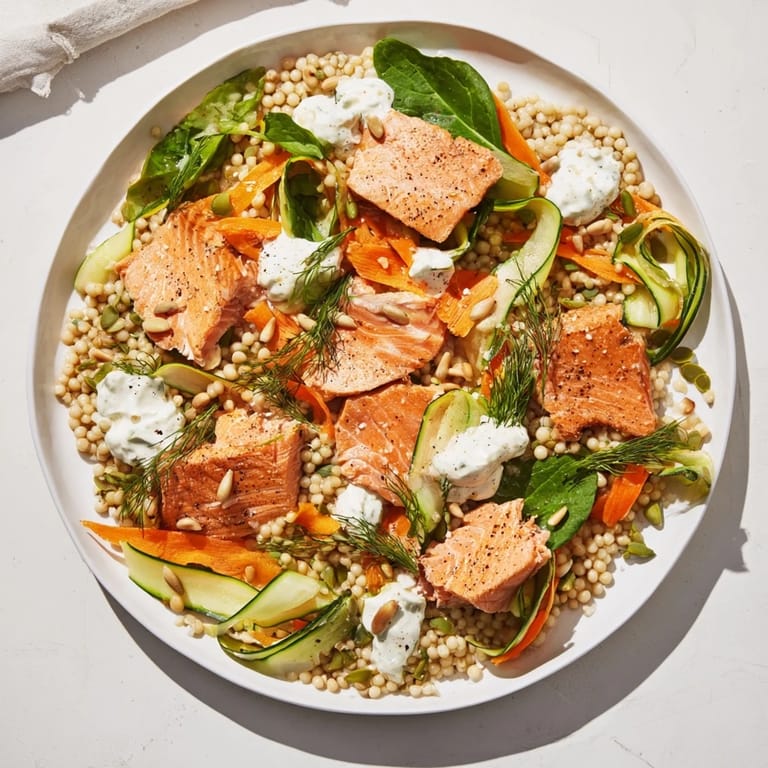
- Now for the part that feels like meditation and art combined. On your largest, most beautiful platter, begin spooning the pearl couscous in a graceful figure-eight shape. Take your time here; this is not a rush. Imagine you're drawing with your spoon. Once your base loop is established, begin arranging your blanched vegetables along its curves. Alternate the colors—zucchini, carrot, fennel—so the eye travels smoothly. Tuck the baby spinach leaves into the spaces, letting them add depth and green. Now, nestle the salmon flakes into the curves of your couscous, distributing them so every section of the loop will have salmon. Dot the yogurt dressing artfully around the loop, then finish with a scatter of capers and a final sprinkle of toasted pine nuts
- Serve with intention:
- Bring the platter to the table immediately. Let people see it before it's disturbed. As you serve, ensure each plate captures a section of the loop—some couscous, some of each vegetable, salmon, that creamy dressing, a hint of brine from the capers, and the warmth of the nuts. Each bite should feel like a conversation between all these elements
 Pin it
 There's something that happens when you sit down to eat something you've arranged with such care—the act of eating slows down, becomes more intentional. I watched my dinner guests that evening move their forks around the plate, following the infinity loop, and I realized that food arranged with love tastes better because we eat it differently. The Infinity Loop Flow isn't just nourishment; it's an invitation to pay attention.
Why Arrangement Matters
In all my years of cooking, I've noticed that people eat with their eyes first. When something is arranged beautifully, we approach it with reverence rather than hunger. The infinity loop shape specifically creates a visual rhythm that your eye naturally follows, and somehow your palate follows too. There's a reason plating is considered an art form in fine dining—it changes the entire experience of the meal. This dish taught me that home cooking doesn't have to sacrifice beauty for simplicity.
The Best Time to Make This
I find myself making the Infinity Loop Flow when I want to celebrate something without the heaviness of a traditional special-occasion meal. It works beautifully in spring and early summer when fresh vegetables are at their peak and lighter meals feel right. The total time of just over an hour means you can have it on the table for dinner without spending your entire afternoon cooking. It's elegant enough for impressing guests, yet simple enough that you're not stressed while preparing it. The pescatarian nature makes it inclusive too—I've never had anyone feel excluded from this meal, whether they eat meat or not.
Customization and Variation
One of my favorite things about this recipe is how it invites personalization while maintaining its essential character. I've served it with radish slices for extra peppery brightness, with thin beet slices for an earthy sweetness, and I've even experimented with thinly sliced beets that stain everything a beautiful deep pink—save that variation for when you're feeling adventurous. If salmon isn't in your pantry or budget, trout brings a similar delicacy while cod offers a firmer texture that also works beautifully. I've discovered that the vegetable choices can shift with the seasons: asparagus in spring, thin-cut green beans in summer, even thinly shaved mushrooms for earthiness. The couscous grounds everything, and the yogurt dressing remains your constant friend.
- Try adding paper-thin radish slices for a peppery contrast that wakes up the palate
- Substitute trout or cod if salmon isn't available—each brings its own character to the dish
- Experiment with seasonal vegetables while keeping the overall structure intact
 Pin it
 The Infinity Loop Flow reminds me that cooking is about more than feeding ourselves—it's about creating moments where people feel seen and cared for. Make this when you have time to breathe through the process, and you'll find it becomes meditation as much as cooking.
Recipe FAQ
- → How is the salmon prepared for this dish?
The salmon fillets are rubbed with olive oil, seasoned with salt and pepper, then baked until just cooked through before being flaked for serving.
- → What vegetables are included and how are they treated?
Thinly sliced zucchini, carrot, and fennel are briefly blanched to preserve color and texture, then cooled before being layered with baby spinach.
- → What grain is used in this dish?
Pearl couscous is gently simmered in vegetable broth until tender, providing a mild base that complements the other ingredients.
- → What flavors enhance the dish's dressing?
A yogurt-based dressing infused with lemon zest and fresh dill brings a creamy, bright contrast to the savory and fresh elements.
- → How is the dish arranged for serving?
The components are artfully organized in a continuous figure-eight pattern, alternating colorful vegetables and nestled salmon flakes for an elegant presentation.
- → Can substitutions be made for the fish?
Trout or cod can be used instead of salmon, offering alternative flavor profiles while maintaining the dish's balance.